
Search landscape
We review current results to understand user intent and competing claims, not to copy their wording or treat their claims as evidence.
About this publication
Allpanel Exchange India is an agency-owned editorial property. It does not provide account, payment or gaming services.
Searches for Allpanel Exchange lead to multiple domains, spellings and promotional claims. Our editorial desk organises the main user questions—access, accounts, apps, exchange terms, payments, legal context and harm reduction—into a navigable independent resource.
Content is published by the Allpanel Exchange India Editorial Desk, an in-house SEO and editorial team. We use a desk identity rather than inventing an individual author, biography or first-hand experience.
We review current results to understand user intent and competing claims, not to copy their wording or treat their claims as evidence.
Government and official sources are preferred for law, enforcement and public reporting routes.
We omit unverified offers, payment speeds, licences, user counts, ratings, security guarantees and ownership claims.
Pages are reviewed when source material or user needs change; dates are not changed solely to appear fresh.
The business model is affiliate publishing. A marked Sign up link may earn this publication compensation without changing the visitor’s price. All Sign up buttons use one centrally configured external destination; this publication does not operate that destination.
This static site includes a third-party traffic-measurement script but no user accounts or forms. It does not collect passwords, OTPs, payment details or identity documents. Standard hosting infrastructure may process routine request data such as IP addresses and user-agent strings; hosting logs are controlled by the eventual hosting provider.
We aim to distinguish verified public information from general education. We do not guarantee that a third-party site remains available, safe or lawful. This publication controls allpanelexchangeold.com as its web address but does not claim ownership of the Allpanel Exchange brand.
We do not promise winnings, host an APK, accept deposits or provide strategies described as guaranteed. Adults should review current law and the responsible-play guide before considering any real-money service.
Detailed editorial standards, affiliate disclosure and privacy guide
Direct answer: This page explains who publishes the guide, what the editorial desk can responsibly say, how commercial links are handled and what the site does not collect. Use it to judge the publication process rather than treating a polished design or a brand-shaped domain as authority.
For this page, the useful question is practical: what can you verify before the decision becomes costly or difficult to reverse? The page focus here is Allpanel Exchange editorial standards and publication boundaries. Keep the conclusion narrower than the evidence. A familiar name, attractive interface or successful page load is not enough to prove operator identity, legal status, payment performance or account safety.
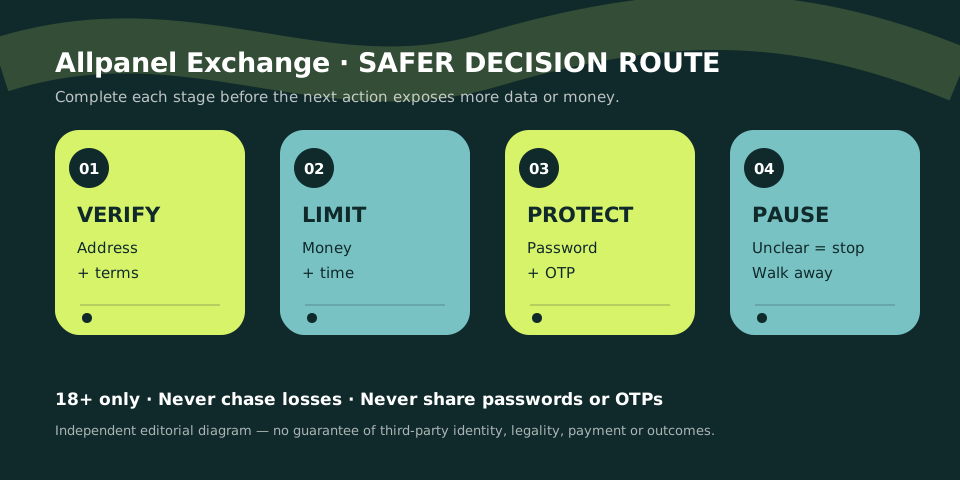
Work in sequence and write down the result of each check. A short record reduces the chance that urgency, memory or a persuasive chat message will replace the facts you actually observed. Allpanel Exchange Guide does not receive passwords, OTPs, payment credentials or identity documents, and it cannot verify private account outcomes.
Terminology before action
Definitions matter because a familiar word can create false confidence. Read the term together with the rule, screen or evidence that gives it meaning. If a third-party page uses different language, do not assume the outcome or obligation is unchanged.
A brand-based publishing identity used when no named individual author has been supplied or verified. In the context of Allpanel Exchange editorial standards and publication boundaries, use this term only as precisely as the applicable page or rule allows; similar labels can conceal different conditions.
An official law, regulator notice, provider document or original record closest to the claim being checked. In the context of Allpanel Exchange editorial standards and publication boundaries, use this term only as precisely as the applicable page or rule allows; similar labels can conceal different conditions.
A clear statement that the publisher may receive value if a reader follows a marked commercial link. In the context of Allpanel Exchange editorial standards and publication boundaries, use this term only as precisely as the applicable page or rule allows; similar labels can conceal different conditions.
A change made because facts, guidance or material context changed, not a cosmetic date refresh. In the context of Allpanel Exchange editorial standards and publication boundaries, use this term only as precisely as the applicable page or rule allows; similar labels can conceal different conditions.
Collecting no more information than a service genuinely needs; this static guide avoids account and payment collection. In the context of Allpanel Exchange editorial standards and publication boundaries, use this term only as precisely as the applicable page or rule allows; similar labels can conceal different conditions.
A process for identifying a material error, reviewing its source and updating the affected guidance. In the context of Allpanel Exchange editorial standards and publication boundaries, use this term only as precisely as the applicable page or rule allows; similar labels can conceal different conditions.
A repeatable process
Follow these steps in order. Earlier checks are deliberately low commitment; later steps can expose identity, device access or money. Stop as soon as a material requirement is unclear or conflicts with your legal, financial or personal boundary.
Look for a consistent editorial identity and a plain explanation of the site’s independent relationship. Complete this check before moving to a step that exposes more personal information or money. Record what you verified, where you found it and what remains uncertain.
Confirm whether the site operates accounts or merely explains navigation, safety, terminology and risk. Complete this check before moving to a step that exposes more personal information or money. Record what you verified, where you found it and what remains uncertain.
Notice whether claims are supported, qualified or clearly described as unverified. Complete this check before moving to a step that exposes more personal information or money. Record what you verified, where you found it and what remains uncertain.
Affiliate links should be recognisable and should not be presented as neutral proof of quality. Complete this check before moving to a step that exposes more personal information or money. Record what you verified, where you found it and what remains uncertain.
A static guide should not ask for passwords, OTPs, payment credentials or identity documents. Complete this check before moving to a step that exposes more personal information or money. Record what you verified, where you found it and what remains uncertain.
Useful maintenance explains what changed instead of repeatedly stamping a fresh date on unchanged copy. Complete this check before moving to a step that exposes more personal information or money. Record what you verified, where you found it and what remains uncertain.
When something material appears wrong, preserve the URL and wording so the editorial desk can review it. Complete this check before moving to a step that exposes more personal information or money. Record what you verified, where you found it and what remains uncertain.
Compare the signal with the response
Use the table to convert observations into actions. It avoids two common extremes: treating a small positive sign as total approval, or continuing to send information and money merely to resolve uncertainty.
| What you observe | What it means | Safer next step |
|---|---|---|
| Named operator relationship absent | The site should remain clearly independent. This is a decision signal, not a complete safety verdict. | Do not infer official status. Keep the response within your pre-set money, time and privacy boundaries. |
| Claim has a primary source | It can be checked against evidence. This is a decision signal, not a complete safety verdict. | Read the source in context. Keep the response within your pre-set money, time and privacy boundaries. |
| Claim is promotional only | Evidence is missing. This is a decision signal, not a complete safety verdict. | Treat it as unverified. Keep the response within your pre-set money, time and privacy boundaries. |
| Page requests secret data | The guide has crossed its stated scope. This is a decision signal, not a complete safety verdict. | Do not submit anything. Keep the response within your pre-set money, time and privacy boundaries. |
| Commercial link is labelled | The incentive is visible. This is a decision signal, not a complete safety verdict. | Still evaluate the destination independently. Keep the response within your pre-set money, time and privacy boundaries. |
Risks worth spotting early
Most preventable harm begins with a shortcut: assuming the name proves identity, letting urgency replace verification, or redefining an affordable limit after a loss. These patterns are more important than small cosmetic differences between pages.
A realistic name, portrait or biography is not trustworthy when the person and qualifications cannot be verified. The practical correction is to pause, return to the relevant evidence and avoid making the next action larger simply because time has already been spent.
Cosmetic timestamps can create a false impression that facts were recently rechecked. The practical correction is to pause, return to the relevant evidence and avoid making the next action larger simply because time has already been spent.
Readers cannot weigh incentives properly if the commercial relationship is obscured. The practical correction is to pause, return to the relevant evidence and avoid making the next action larger simply because time has already been spent.
A privacy statement has little value if the site quietly collects sensitive account details. The practical correction is to pause, return to the relevant evidence and avoid making the next action larger simply because time has already been spent.
A publisher should distinguish general guidance, sourced facts and unresolved operator claims. The practical correction is to pause, return to the relevant evidence and avoid making the next action larger simply because time has already been spent.
Put the checklist into practice
Scenarios reveal how several risks combine. The details will vary, but a sound response usually slows the decision, separates the communication route from the verification route and keeps financial exposure from growing.
Situation: The message identifies the exact URL, passage and a relevant official source.
Safer response: The editorial desk can compare the source, amend the material statement and record a substantive update. A correction should improve the page, not merely change its date.
Notice the pattern: the response protects credentials, preserves a record and keeps the reader free to walk away. It does not promise that a disputed account, transaction or third-party service can be recovered.
Situation: A previously configured link redirects somewhere unexpected or no longer matches the described purpose.
Safer response: The safe response is to disable or review the route, not to assume the redirect is harmless. Commercial convenience never overrides destination verification.
Notice the pattern: the response protects credentials, preserves a record and keeps the reader free to walk away. It does not promise that a disputed account, transaction or third-party service can be recovered.
Situation: Someone offers an ID image or payment record while asking the guide to fix an account.
Safer response: The guide should not receive account documents. The visitor should use a verified service or official authority route and redact unnecessary secrets from any evidence they retain.
Notice the pattern: the response protects credentials, preserves a record and keeps the reader free to walk away. It does not promise that a disputed account, transaction or third-party service can be recovered.
Evidence boundary
This Allpanel Exchange page can explain editorial standards, affiliate disclosure and privacy for Allpanel Exchange editorial standards and publication boundaries, organise questions and show how to preserve useful records. It does not establish that a third-party domain is official, that an operator is licensed for a reader’s location, that a payment will be returned, or that any game outcome can be predicted.
Current details should be checked at the moment they matter. Terms, domains, app files, support routes and legal context can change. Prefer official primary material for changing public rules and use qualified professional advice when the consequences are material.
Keep sensitive information outside the research process. Redact passwords, OTPs, card security codes, recovery codes and unrelated identity data from any record you retain. If you suspect fraud or unauthorised access, use the official channel of your bank, payment provider, email service or relevant authority—not a number supplied by an unknown intermediary.
Clear answers
No. The editorial desk publishes information and does not operate accounts, games or payments. When a material fact is missing, keep the conclusion cautious and use the relevant internal guide to complete the next check.
It creates an incentive that must be disclosed; factual claims still need the same evidence and qualification. When a material fact is missing, keep the conclusion cautious and use the relevant internal guide to complete the next check.
No. This guide does not need or request passwords, OTPs, bank details or identity files. When a material fact is missing, keep the conclusion cautious and use the relevant internal guide to complete the next check.
Include the exact page URL, the statement in question and a reliable supporting source without sending private credentials. When a material fact is missing, keep the conclusion cautious and use the relevant internal guide to complete the next check.
When ownership, licensing, payment or offer details cannot be supported reliably, omission is more honest than invented certainty. When a material fact is missing, keep the conclusion cautious and use the relevant internal guide to complete the next check.