
Who is the operator?
Look for a legal entity, usable terms and a clear way to raise an account complaint. A brand name alone is not enough.
Account guide
Account creation is the point to slow down. Confirm who operates the service, what an ID unlocks, how funds are handled and whether participation is permitted where you are.
Look for a legal entity, usable terms and a clear way to raise an account complaint. A brand name alone is not enough.
Check current national and state requirements. Do not infer legality from availability.
Ask whether the ID is for a sports exchange, casino lobby, demo environment or multiple services.
Understand deposit, stake, loss, session and withdrawal controls before funding.
The payment recipient should be explained before any transfer. Avoid unexplained personal accounts.
Look for self-exclusion, timeout and closure routes that do not require continued play.
A regulated service may request identity and age verification. Before sending documents, confirm the privacy policy, data controller, purpose, retention period and secure upload method. Do not send identity files into an unverified chat.
Proceed only if you can identify the destination, understand the terms, accept the risk of loss and confirm the activity is allowed. Otherwise, the correct action is not to create an account.
Detailed signup eligibility and account creation guide
Direct answer: Do the decision work before opening an account: confirm eligibility, understand who receives your information, read the terms, set financial limits and verify the destination. Signup should never begin through an agent who asks for a password, OTP, remote access or payment to create an ID.
For this page, the useful question is practical: what can you verify before the decision becomes costly or difficult to reverse? The page focus here is Allpanel Exchange signup, ID and eligibility checks. Keep the conclusion narrower than the evidence. A familiar name, attractive interface or successful page load is not enough to prove operator identity, legal status, payment performance or account safety.
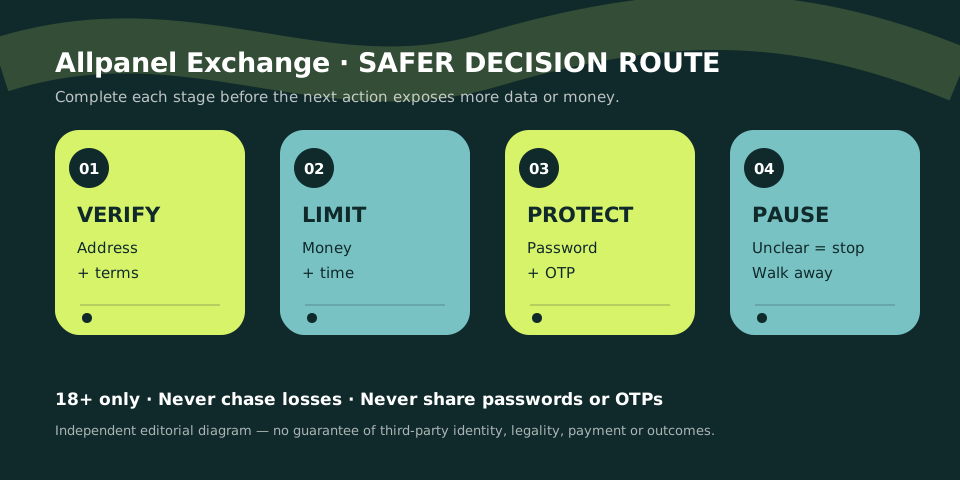
Work in sequence and write down the result of each check. A short record reduces the chance that urgency, memory or a persuasive chat message will replace the facts you actually observed. Allpanel Exchange Guide does not receive passwords, OTPs, payment credentials or identity documents, and it cannot verify private account outcomes.
Terminology before action
Definitions matter because a familiar word can create false confidence. Read the term together with the rule, screen or evidence that gives it meaning. If a third-party page uses different language, do not assume the outcome or obligation is unchanged.
The age, location and other conditions a person must meet before an account can lawfully and validly be opened. In the context of Allpanel Exchange signup, ID and eligibility checks, use this term only as precisely as the applicable page or rule allows; similar labels can conceal different conditions.
The personal details attached to an account, which should not be borrowed, rented or fabricated. In the context of Allpanel Exchange signup, ID and eligibility checks, use this term only as precisely as the applicable page or rule allows; similar labels can conceal different conditions.
An identity-check process whose documents, controller, retention and security should be understood before submission. In the context of Allpanel Exchange signup, ID and eligibility checks, use this term only as precisely as the applicable page or rule allows; similar labels can conceal different conditions.
Agreement to rules governing accounts, settlement, promotions, payments, suspension and disputes. In the context of Allpanel Exchange signup, ID and eligibility checks, use this term only as precisely as the applicable page or rule allows; similar labels can conceal different conditions.
An account offered through an intermediary, which can obscure the operator, recovery route and data controller. In the context of Allpanel Exchange signup, ID and eligibility checks, use this term only as precisely as the applicable page or rule allows; similar labels can conceal different conditions.
A money or time boundary chosen before the first deposit rather than after activity begins. In the context of Allpanel Exchange signup, ID and eligibility checks, use this term only as precisely as the applicable page or rule allows; similar labels can conceal different conditions.
A repeatable process
Follow these steps in order. Earlier checks are deliberately low commitment; later steps can expose identity, device access or money. Stop as soon as a material requirement is unclear or conflicts with your legal, financial or personal boundary.
Stop if the activity is not permitted for you or if the applicable rule remains unclear. Complete this check before moving to a step that exposes more personal information or money. Record what you verified, where you found it and what remains uncertain.
Read the exact hostname and avoid forms reached only through unsolicited messages. Complete this check before moving to a step that exposes more personal information or money. Record what you verified, where you found it and what remains uncertain.
Understand who controls the account, data, terms and complaint process. Complete this check before moving to a step that exposes more personal information or money. Record what you verified, where you found it and what remains uncertain.
Review suspension, verification, withdrawal, promotion and dispute conditions before acceptance. Complete this check before moving to a step that exposes more personal information or money. Record what you verified, where you found it and what remains uncertain.
Upload only through a verified process and never send documents casually in chat. Complete this check before moving to a step that exposes more personal information or money. Record what you verified, where you found it and what remains uncertain.
Use a password not shared with email, banking or other services and keep OTPs private. Complete this check before moving to a step that exposes more personal information or money. Record what you verified, where you found it and what remains uncertain.
Choose loss and time limits, no borrowing and a support action before the account is used. Complete this check before moving to a step that exposes more personal information or money. Record what you verified, where you found it and what remains uncertain.
Compare the signal with the response
Use the table to convert observations into actions. It avoids two common extremes: treating a small positive sign as total approval, or continuing to send information and money merely to resolve uncertainty.
| What you observe | What it means | Safer next step |
|---|---|---|
| Eligibility is unresolved | Account creation may be inappropriate. This is a decision signal, not a complete safety verdict. | Do not sign up. Keep the response within your pre-set money, time and privacy boundaries. |
| Terms are available and readable | Conditions can be assessed. This is a decision signal, not a complete safety verdict. | Save the applicable version. Keep the response within your pre-set money, time and privacy boundaries. |
| An agent controls the password | Account security is compromised. This is a decision signal, not a complete safety verdict. | Refuse the arrangement. Keep the response within your pre-set money, time and privacy boundaries. |
| Documents go through chat | Data handling is unclear. This is a decision signal, not a complete safety verdict. | Do not send them. Keep the response within your pre-set money, time and privacy boundaries. |
| No affordable limit exists | Participation is financially unsafe. This is a decision signal, not a complete safety verdict. | Do not fund the account. Keep the response within your pre-set money, time and privacy boundaries. |
Risks worth spotting early
Most preventable harm begins with a shortcut: assuming the name proves identity, letting urgency replace verification, or redefining an affordable limit after a loss. These patterns are more important than small cosmetic differences between pages.
Creating an account can disclose data and trigger marketing before the terms are understood. The practical correction is to pause, return to the relevant evidence and avoid making the next action larger simply because time has already been spent.
Someone else may retain access to the account and recovery information. The practical correction is to pause, return to the relevant evidence and avoid making the next action larger simply because time has already been spent.
Borrowed details create security, payment, eligibility and dispute problems. The practical correction is to pause, return to the relevant evidence and avoid making the next action larger simply because time has already been spent.
Important rules may affect withdrawal, verification, suspension and complaint rights. The practical correction is to pause, return to the relevant evidence and avoid making the next action larger simply because time has already been spent.
The first payment can turn a research task into immediate financial exposure. The practical correction is to pause, return to the relevant evidence and avoid making the next action larger simply because time has already been spent.
Put the checklist into practice
Scenarios reveal how several risks combine. The details will vary, but a sound response usually slows the decision, separates the communication route from the verification route and keeps financial exposure from growing.
Situation: A message promises an account in minutes if the user sends a phone number, OTP and payment.
Safer response: Do not continue. An OTP is a secret, and account ownership is unclear when an intermediary creates credentials. Verify the service independently and keep personal data out of chat.
Notice the pattern: the response protects credentials, preserves a record and keeps the reader free to walk away. It does not promise that a disputed account, transaction or third-party service can be recovered.
Situation: The account form is short, but important payment and suspension rules only become visible later.
Safer response: Stop before funding. Locate and save the complete terms first; a quick form does not reduce the importance of the obligations attached to it.
Notice the pattern: the response protects credentials, preserves a record and keeps the reader free to walk away. It does not promise that a disputed account, transaction or third-party service can be recovered.
Situation: The process asks for more identity material than the purpose appears to require.
Safer response: Do not upload by default. Verify the controller, purpose, security and retention, and leave if the request cannot be explained credibly.
Notice the pattern: the response protects credentials, preserves a record and keeps the reader free to walk away. It does not promise that a disputed account, transaction or third-party service can be recovered.
Evidence boundary
This Allpanel Exchange page can explain signup eligibility and account creation for Allpanel Exchange signup, ID and eligibility checks, organise questions and show how to preserve useful records. It does not establish that a third-party domain is official, that an operator is licensed for a reader’s location, that a payment will be returned, or that any game outcome can be predicted.
Current details should be checked at the moment they matter. Terms, domains, app files, support routes and legal context can change. Prefer official primary material for changing public rules and use qualified professional advice when the consequences are material.
Keep sensitive information outside the research process. Redact passwords, OTPs, card security codes, recovery codes and unrelated identity data from any record you retain. If you suspect fraud or unauthorised access, use the official channel of your bank, payment provider, email service or relevant authority—not a number supplied by an unknown intermediary.
Clear answers
No. It provides information and does not operate IDs or signup forms. When a material fact is missing, keep the conclusion cautious and use the relevant internal guide to complete the next check.
No. Never share OTPs, passwords or recovery codes. When a material fact is missing, keep the conclusion cautious and use the relevant internal guide to complete the next check.
Review eligibility, identity checks, payments, withdrawal, promotions, suspension and disputes. When a material fact is missing, keep the conclusion cautious and use the relevant internal guide to complete the next check.
No. Verify who collects the document, why it is needed, how it is secured and how long it is retained. When a material fact is missing, keep the conclusion cautious and use the relevant internal guide to complete the next check.
Stop when eligibility, destination, operator identity, terms, data handling or an affordable limit cannot be established. When a material fact is missing, keep the conclusion cautious and use the relevant internal guide to complete the next check.