
You support an outcome
A back position generally wins if the selected outcome occurs. Your stake is the amount you put at risk under the displayed terms.
Concept guide
An exchange-style interface is built around positions and counterparties rather than a simple fixed-odds bet against a bookmaker. The labels are easy to recognise but the liability can be easy to underestimate.
A back position generally wins if the selected outcome occurs. Your stake is the amount you put at risk under the displayed terms.
A lay position generally wins if the selected outcome does not occur. Your liability can be greater than the amount you expect to win.
Illustrative lay odds: 4.00
Desired win amount: ₹100
Potential liability: (4.00 − 1) × ₹100 = ₹300
This is a mathematical example, not an offer, recommendation or representation of any Allpanel market.
Never assume the word “exchange” indicates a licence, regulator, guaranteed liquidity or a particular corporate operator. Those are separate facts that require evidence.
Detailed exchange-style back, lay, odds and liability guide
Direct answer: An exchange-style label describes a way of taking positions for or against an outcome; it does not make the activity predictable. The essential number is total exposure, especially lay liability, across every open position under the actual settlement rules.
For this page, the useful question is practical: what can you verify before the decision becomes costly or difficult to reverse? The page focus here is Allpanel Exchange back, lay, odds and liability. Keep the conclusion narrower than the evidence. A familiar name, attractive interface or successful page load is not enough to prove operator identity, legal status, payment performance or account safety.
Work in sequence and write down the result of each check. A short record reduces the chance that urgency, memory or a persuasive chat message will replace the facts you actually observed. Allpanel Exchange Guide does not receive passwords, OTPs, payment credentials or identity documents, and it cannot verify private account outcomes.
Terminology before action
Definitions matter because a familiar word can create false confidence. Read the term together with the rule, screen or evidence that gives it meaning. If a third-party page uses different language, do not assume the outcome or obligation is unchanged.
A position that generally benefits when the selected outcome occurs and loses the stated stake when it does not. In the context of Allpanel Exchange back, lay, odds and liability, use this term only as precisely as the applicable page or rule allows; similar labels can conceal different conditions.
A position that generally benefits when the selected outcome does not occur and creates a separate liability. In the context of Allpanel Exchange back, lay, odds and liability, use this term only as precisely as the applicable page or rule allows; similar labels can conceal different conditions.
The price used to calculate potential return and, for a lay position, the liability at risk. In the context of Allpanel Exchange back, lay, odds and liability, use this term only as precisely as the applicable page or rule allows; similar labels can conceal different conditions.
The maximum amount a lay position can lose if the opposed outcome occurs. In the context of Allpanel Exchange back, lay, odds and liability, use this term only as precisely as the applicable page or rule allows; similar labels can conceal different conditions.
The amount available to be matched at displayed prices; it can change and does not guarantee execution. In the context of Allpanel Exchange back, lay, odds and liability, use this term only as precisely as the applicable page or rule allows; similar labels can conceal different conditions.
The application of published rules to decide whether a position wins, loses, is void or is adjusted. In the context of Allpanel Exchange back, lay, odds and liability, use this term only as precisely as the applicable page or rule allows; similar labels can conceal different conditions.
A repeatable process
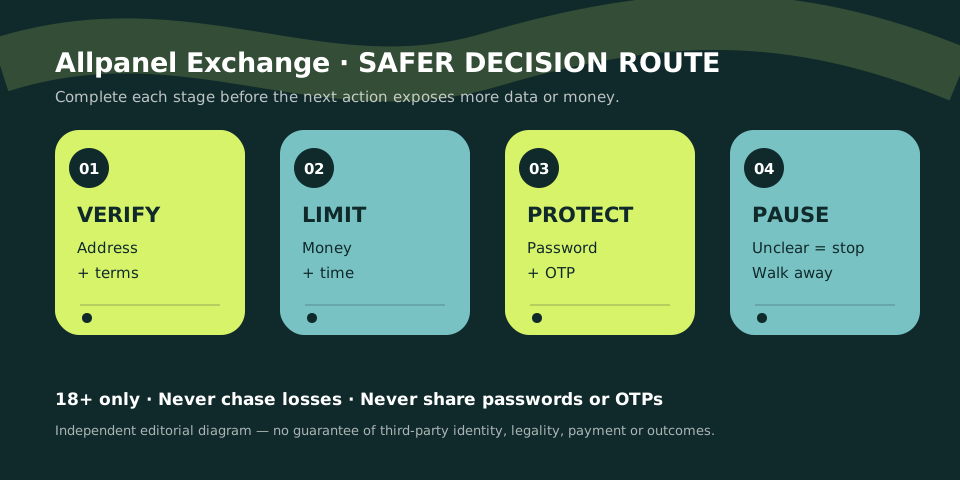
Follow these steps in order. Earlier checks are deliberately low commitment; later steps can expose identity, device access or money. Stop as soon as a material requirement is unclear or conflicts with your legal, financial or personal boundary.
Write down exactly what must happen for the position to settle in your favour. Complete this check before moving to a step that exposes more personal information or money. Record what you verified, where you found it and what remains uncertain.
Confirm whether the action is backing an outcome or laying against it. Complete this check before moving to a step that exposes more personal information or money. Record what you verified, where you found it and what remains uncertain.
Convert the displayed odds into the full worst-case amount before confirmation. Complete this check before moving to a step that exposes more personal information or money. Record what you verified, where you found it and what remains uncertain.
Review void, tie, cancellation, interruption and dead-heat conditions where relevant. Complete this check before moving to a step that exposes more personal information or money. Record what you verified, where you found it and what remains uncertain.
Add related open positions rather than evaluating each ticket in isolation. Complete this check before moving to a step that exposes more personal information or money. Record what you verified, where you found it and what remains uncertain.
The total potential loss must remain within a pre-set amount that does not affect essentials. Complete this check before moving to a step that exposes more personal information or money. Record what you verified, where you found it and what remains uncertain.
Do not change the limit simply because prices move or an earlier position loses. Complete this check before moving to a step that exposes more personal information or money. Record what you verified, where you found it and what remains uncertain.
Compare the signal with the response
Use the table to convert observations into actions. It avoids two common extremes: treating a small positive sign as total approval, or continuing to send information and money merely to resolve uncertainty.
| What you observe | What it means | Safer next step |
|---|---|---|
| Back stake is understood | Loss is usually limited to that stake. This is a decision signal, not a complete safety verdict. | Still check settlement rules. Keep the response within your pre-set money, time and privacy boundaries. |
| Lay liability is displayed | Maximum loss can be assessed. This is a decision signal, not a complete safety verdict. | Compare it with your total limit. Keep the response within your pre-set money, time and privacy boundaries. |
| Price moves before matching | Expected terms changed. This is a decision signal, not a complete safety verdict. | Recalculate or cancel the idea. Keep the response within your pre-set money, time and privacy boundaries. |
| Rule wording is ambiguous | Settlement is uncertain. This is a decision signal, not a complete safety verdict. | Do not take the position. Keep the response within your pre-set money, time and privacy boundaries. |
| Several outcomes are linked | Worst cases may overlap. This is a decision signal, not a complete safety verdict. | Assess the portfolio together. Keep the response within your pre-set money, time and privacy boundaries. |
Risks worth spotting early
Most preventable harm begins with a shortcut: assuming the name proves identity, letting urgency replace verification, or redefining an affordable limit after a loss. These patterns are more important than small cosmetic differences between pages.
A prominent upside figure can distract from the amount that is actually at risk. The practical correction is to pause, return to the relevant evidence and avoid making the next action larger simply because time has already been spent.
The real liability can be substantially larger depending on the odds. The practical correction is to pause, return to the relevant evidence and avoid making the next action larger simply because time has already been spent.
Displayed availability can change before an order is accepted. The practical correction is to pause, return to the relevant evidence and avoid making the next action larger simply because time has already been spent.
A second position can reduce one outcome while increasing fees or another exposure. The practical correction is to pause, return to the relevant evidence and avoid making the next action larger simply because time has already been spent.
Fast price movement encourages reactive decisions that bypass the original loss ceiling. The practical correction is to pause, return to the relevant evidence and avoid making the next action larger simply because time has already been spent.
Put the checklist into practice
Scenarios reveal how several risks combine. The details will vary, but a sound response usually slows the decision, separates the communication route from the verification route and keeps financial exposure from growing.
Situation: The quoted odds move between calculation and confirmation, increasing the liability.
Safer response: Recalculate from the new price. Do not rely on the earlier number or proceed from momentum; a changed maximum loss means the original decision no longer applies.
Notice the pattern: the response protects credentials, preserves a record and keeps the reader free to walk away. It does not promise that a disputed account, transaction or third-party service can be recovered.
Situation: A user adds another outcome expecting it to remove risk completely.
Safer response: Map every possible settlement result and include charges or unmatched amounts. A hedge is only understood when the full outcome table, not just one screen, has been reviewed.
Notice the pattern: the response protects credentials, preserves a record and keeps the reader free to walk away. It does not promise that a disputed account, transaction or third-party service can be recovered.
Situation: Play stops and the user expects the selection to be void automatically.
Safer response: Open the exact settlement rule. Different markets can use different completion thresholds, so an intuitive sporting interpretation may not match the contract.
Notice the pattern: the response protects credentials, preserves a record and keeps the reader free to walk away. It does not promise that a disputed account, transaction or third-party service can be recovered.
Evidence boundary
This Allpanel Exchange page can explain exchange-style back, lay, odds and liability for Allpanel Exchange back, lay, odds and liability, organise questions and show how to preserve useful records. It does not establish that a third-party domain is official, that an operator is licensed for a reader’s location, that a payment will be returned, or that any game outcome can be predicted.
Current details should be checked at the moment they matter. Terms, domains, app files, support routes and legal context can change. Prefer official primary material for changing public rules and use qualified professional advice when the consequences are material.
Keep sensitive information outside the research process. Redact passwords, OTPs, card security codes, recovery codes and unrelated identity data from any record you retain. If you suspect fraud or unauthorised access, use the official channel of your bank, payment provider, email service or relevant authority—not a number supplied by an unknown intermediary.
Clear answers
No format removes uncertainty; exchange-style lay positions can create liabilities larger than the displayed stake. When a material fact is missing, keep the conclusion cautious and use the relevant internal guide to complete the next check.
A common simplified form is stake multiplied by odds minus one, but the actual interface and rules must be checked. When a material fact is missing, keep the conclusion cautious and use the relevant internal guide to complete the next check.
No. Availability and price can change before an order is accepted. When a material fact is missing, keep the conclusion cautious and use the relevant internal guide to complete the next check.
Yes. Total exposure across related markets matters more than the size of any single action. When a material fact is missing, keep the conclusion cautious and use the relevant internal guide to complete the next check.
Review outcome definition, position type, full liability, settlement rules and the combined event limit. When a material fact is missing, keep the conclusion cautious and use the relevant internal guide to complete the next check.