
Match outcome
A position on the overall match result. Draw, tie, no-result and shortened-match rules can matter.
Cricket guide
Cricket creates many possible market labels across formats, but every additional outcome adds a settlement rule to understand. This is terminology education, not a claim about currently available Allpanel markets.
A position on the overall match result. Draw, tie, no-result and shortened-match rules can matter.
A position related to runs, wickets or another innings statistic. Check the exact interval and settlement source.
A named player statistic. Playing XI changes, substitutes and retired-hurt rules can affect settlement.
A narrower period such as a set of overs. Fast settlement does not reduce financial risk.
Broadcast pictures, score apps and market feeds can arrive at different times. A price may move before your request reaches the market. Check the confirmation state rather than assuming a tap created the position you intended.
For the mechanics behind prices and liability, read the exchange terms guide. For financial boundaries, use the responsible-use plan.
Detailed cricket market terminology and exposure guide
Direct answer: Read a cricket market as a contract with a specific event, settlement rule and financial exposure. Team familiarity, live commentary and short odds do not explain how a selection settles, what happens after an interruption or how quickly repeated positions can accumulate loss.
For this page, the useful question is practical: what can you verify before the decision becomes costly or difficult to reverse? The page focus here is Allpanel Exchange cricket markets, settlement and match limits. Keep the conclusion narrower than the evidence. A familiar name, attractive interface or successful page load is not enough to prove operator identity, legal status, payment performance or account safety.
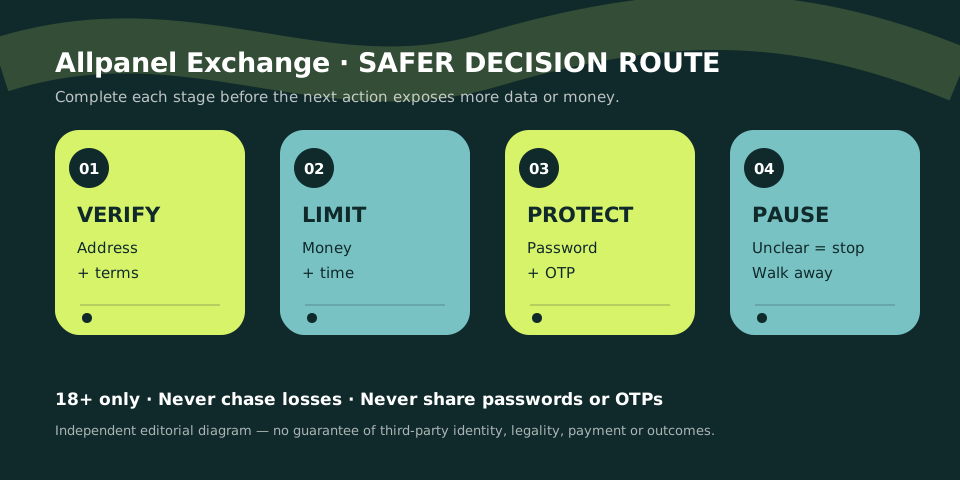
Work in sequence and write down the result of each check. A short record reduces the chance that urgency, memory or a persuasive chat message will replace the facts you actually observed. Allpanel Exchange Guide does not receive passwords, OTPs, payment credentials or identity documents, and it cannot verify private account outcomes.
Terminology before action
Definitions matter because a familiar word can create false confidence. Read the term together with the rule, screen or evidence that gives it meaning. If a third-party page uses different language, do not assume the outcome or obligation is unchanged.
A market usually tied to the declared result of a match, subject to its own tie, no-result and abandonment rules. In the context of Allpanel Exchange cricket markets, settlement and match limits, use this term only as precisely as the applicable page or rule allows; similar labels can conceal different conditions.
A selection based on an innings outcome or total, with settlement affected by the published market definition. In the context of Allpanel Exchange cricket markets, settlement and match limits, use this term only as precisely as the applicable page or rule allows; similar labels can conceal different conditions.
A short segment or interval whose narrow timeframe can encourage repeated, fast decisions. In the context of Allpanel Exchange cricket markets, settlement and match limits, use this term only as precisely as the applicable page or rule allows; similar labels can conceal different conditions.
A position that generally benefits if the selected outcome occurs, with stake still at risk. In the context of Allpanel Exchange cricket markets, settlement and match limits, use this term only as precisely as the applicable page or rule allows; similar labels can conceal different conditions.
A position against an outcome; the displayed stake can differ from the liability at risk. In the context of Allpanel Exchange cricket markets, settlement and match limits, use this term only as precisely as the applicable page or rule allows; similar labels can conceal different conditions.
The written condition that decides the result after interruptions, revised targets, ties or incomplete play. In the context of Allpanel Exchange cricket markets, settlement and match limits, use this term only as precisely as the applicable page or rule allows; similar labels can conceal different conditions.
A repeatable process
Follow these steps in order. Earlier checks are deliberately low commitment; later steps can expose identity, device access or money. Stop as soon as a material requirement is unclear or conflicts with your legal, financial or personal boundary.
Do not treat match, innings, player and session labels as interchangeable. Complete this check before moving to a step that exposes more personal information or money. Record what you verified, where you found it and what remains uncertain.
Read settlement wording before taking a position, especially for shortened or abandoned play. Complete this check before moving to a step that exposes more personal information or money. Record what you verified, where you found it and what remains uncertain.
Include lay liability and all open related positions rather than looking at one stake. Complete this check before moving to a step that exposes more personal information or money. Record what you verified, where you found it and what remains uncertain.
Live pictures, score feeds and market updates may not reach every user simultaneously. Complete this check before moving to a step that exposes more personal information or money. Record what you verified, where you found it and what remains uncertain.
Team loyalty and commentary excitement do not change probability or affordability. Complete this check before moving to a step that exposes more personal information or money. Record what you verified, where you found it and what remains uncertain.
Create one cap for the full event so repeated small positions do not bypass the budget. Complete this check before moving to a step that exposes more personal information or money. Record what you verified, where you found it and what remains uncertain.
Separate whether a prediction was right from whether the process and risk boundary were sound. Complete this check before moving to a step that exposes more personal information or money. Record what you verified, where you found it and what remains uncertain.
Compare the signal with the response
Use the table to convert observations into actions. It avoids two common extremes: treating a small positive sign as total approval, or continuing to send information and money merely to resolve uncertainty.
| What you observe | What it means | Safer next step |
|---|---|---|
| Rules are not visible | Settlement cannot be predicted reliably. This is a decision signal, not a complete safety verdict. | Do not enter the market. Keep the response within your pre-set money, time and privacy boundaries. |
| Liability is unclear | Maximum loss is unknown. This is a decision signal, not a complete safety verdict. | Calculate it before proceeding. Keep the response within your pre-set money, time and privacy boundaries. |
| Feed appears delayed | Information may be stale. This is a decision signal, not a complete safety verdict. | Pause live decisions. Keep the response within your pre-set money, time and privacy boundaries. |
| Several markets overlap | Exposure may be correlated. This is a decision signal, not a complete safety verdict. | Review the combined worst case. Keep the response within your pre-set money, time and privacy boundaries. |
| Loss triggers an immediate new pick | Chasing is beginning. This is a decision signal, not a complete safety verdict. | End the session. Keep the response within your pre-set money, time and privacy boundaries. |
Risks worth spotting early
Most preventable harm begins with a shortcut: assuming the name proves identity, letting urgency replace verification, or redefining an affordable limit after a loss. These patterns are more important than small cosmetic differences between pages.
Displayed prices include market dynamics and do not guarantee the implied outcome frequency. The practical correction is to pause, return to the relevant evidence and avoid making the next action larger simply because time has already been spent.
Several selections can depend on the same wicket, player or match result and fail together. The practical correction is to pause, return to the relevant evidence and avoid making the next action larger simply because time has already been spent.
Rain, revised targets and abandoned play can produce settlement that differs from casual expectations. The practical correction is to pause, return to the relevant evidence and avoid making the next action larger simply because time has already been spent.
High decision frequency compresses reflection and makes a match limit easier to exceed. The practical correction is to pause, return to the relevant evidence and avoid making the next action larger simply because time has already been spent.
Supporting a team can make contrary information feel less credible without changing the financial risk. The practical correction is to pause, return to the relevant evidence and avoid making the next action larger simply because time has already been spent.
Put the checklist into practice
Scenarios reveal how several risks combine. The details will vary, but a sound response usually slows the decision, separates the communication route from the verification route and keeps financial exposure from growing.
Situation: Play is shortened and a revised target applies while several markets remain visible.
Safer response: Stop and read the rule for each exact market. Do not assume every selection follows the final match result or the same abandonment threshold. Unclear settlement is a reason to stay out.
Notice the pattern: the response protects credentials, preserves a record and keeps the reader free to walk away. It does not promise that a disputed account, transaction or third-party service can be recovered.
Situation: A user sees a modest stake beside a lay selection and overlooks the larger liability.
Safer response: Calculate the maximum loss in rupees before confirming anything. The liability, not the label beside the button, is the number that belongs in the event budget.
Notice the pattern: the response protects credentials, preserves a record and keeps the reader free to walk away. It does not promise that a disputed account, transaction or third-party service can be recovered.
Situation: Commentary and price movement create the feeling that an immediate response is necessary.
Safer response: Let the moment pass. A missed position has no financial cost, while a rushed position can break both the analysis and the pre-set time boundary.
Notice the pattern: the response protects credentials, preserves a record and keeps the reader free to walk away. It does not promise that a disputed account, transaction or third-party service can be recovered.
Evidence boundary
This Allpanel Exchange page can explain cricket market terminology and exposure for Allpanel Exchange cricket markets, settlement and match limits, organise questions and show how to preserve useful records. It does not establish that a third-party domain is official, that an operator is licensed for a reader’s location, that a payment will be returned, or that any game outcome can be predicted.
Current details should be checked at the moment they matter. Terms, domains, app files, support routes and legal context can change. Prefer official primary material for changing public rules and use qualified professional advice when the consequences are material.
Keep sensitive information outside the research process. Redact passwords, OTPs, card security codes, recovery codes and unrelated identity data from any record you retain. If you suspect fraud or unauthorised access, use the official channel of your bank, payment provider, email service or relevant authority—not a number supplied by an unknown intermediary.
Clear answers
No. Any uncertain event can lose, and short prices can still create material loss when stakes or repeated activity increase. When a material fact is missing, keep the conclusion cautious and use the relevant internal guide to complete the next check.
It is the amount at risk when the outcome you opposed occurs; it may be larger than the displayed lay stake. When a material fact is missing, keep the conclusion cautious and use the relevant internal guide to complete the next check.
No. Settlement depends on the exact market rules, which should be read before participation. When a material fact is missing, keep the conclusion cautious and use the relevant internal guide to complete the next check.
Yes. Broadcast, device and network paths can differ, so visible information may not be simultaneous. When a material fact is missing, keep the conclusion cautious and use the relevant internal guide to complete the next check.
Use one affordable cap for the full match plus a time limit and a rule against increasing either after a loss. When a material fact is missing, keep the conclusion cautious and use the relevant internal guide to complete the next check.