
You are repeatedly sent to different personal accounts without a documented reason.
Money safety
Allpanel Exchange payments: verify the recipient before sending
Payment convenience is not proof of legitimacy. Treat every new UPI ID, QR code, bank account or agent instruction as a fresh request that needs verification.
Before any deposit
- 1
Identify the contractual service
Know which entity or operator is supposed to receive or account for your funds.
- 2
Check the payee shown in your payment app
A mismatch, unfamiliar personal name or last-minute recipient change requires an explanation through a trusted channel.
- 3
Read limits and withdrawal terms
Understand minimums, maximums, verification, processing steps and any wagering conditions before paying.
- 4
Record the transaction
Keep the recipient, UTR or transaction ID, timestamp, amount and relevant support thread.
Payment red flags
Support asks for an SMS code, UPI PIN, card PIN or screen-sharing access.
You are told to pay more money before a balance or withdrawal can be released.
A short deadline is used to stop you verifying the recipient or terms.
If a withdrawal is delayed
Do not respond by depositing more. Ask for the written reason, the relevant term, the amount under review and a complaint reference. Preserve the account balance, request history and transaction evidence.
A useful written request is specific: state the withdrawal amount, request time and account reference; ask whether identity verification, a published limit or another stated rule is holding the request; and request a realistic response date. Keep the conversation factual. A promise made in a private message should not replace the terms shown by the service.
Be especially cautious if the explanation keeps changing. A request for a tax payment, clearance charge, security deposit or “refundable” fee should be verified independently before you act. Sending another transfer does not prove that an earlier balance exists or that a later withdrawal will be processed.
When a transfer has gone to the wrong place
Contact the bank or payment provider through its official app, website or phone number as soon as possible. Give the exact transaction reference and explain why you believe the recipient or instruction was fraudulent. The provider—not a chat agent—can explain whether a recall, dispute or fraud-reporting path applies to that payment method.
Do not delete the app, messages or payment history until the relevant evidence is preserved. Save the full URL, the date and time, the recipient name displayed by the payment service, the UPI ID or account details, the amount, the transaction reference and the complete support conversation. Avoid editing screenshots in a way that removes timestamps or context.
Keep account and payment decisions separate
An account-access problem should not automatically require a deposit. Likewise, a withdrawal review should not require you to place another position. When support combines unrelated steps, pause and ask for the published term that connects them. If no clear term is provided, do not send more money.
What to preserveWhy it matters
Transaction ID / UTRLets the bank or payment provider locate the transfer.
Recipient detailsShows where the payment was directed at that time.
Full conversationProvides context; isolated screenshots can omit dates or instructions.
Terms in forceRecords the rules displayed when you acted.
Suspect fraud? Contact your bank or payment provider through its official channel promptly. In India, the national cybercrime reporting portal and helpline information are available at cybercrime.gov.in.
Never send funds simply to recover a prior loss. Use the stop-and-limit plan if play is affecting your finances or decisions.
Detailed deposit, withdrawal and transaction safety guide
A complete decision framework for Allpanel Exchange deposit, withdrawal and UPI safety
Direct answer: Before sending money, identify the recipient, read the applicable deposit and withdrawal terms, and preserve a clean record. A working UPI ID, card page or successful small transfer does not prove ownership, withdrawal reliability or legal status.
For this page, the useful question is practical: what can you verify before the decision becomes costly or difficult to reverse? The page focus here is Allpanel Exchange deposit, withdrawal and UPI safety. Keep the conclusion narrower than the evidence. A familiar name, attractive interface or successful page load is not enough to prove operator identity, legal status, payment performance or account safety.
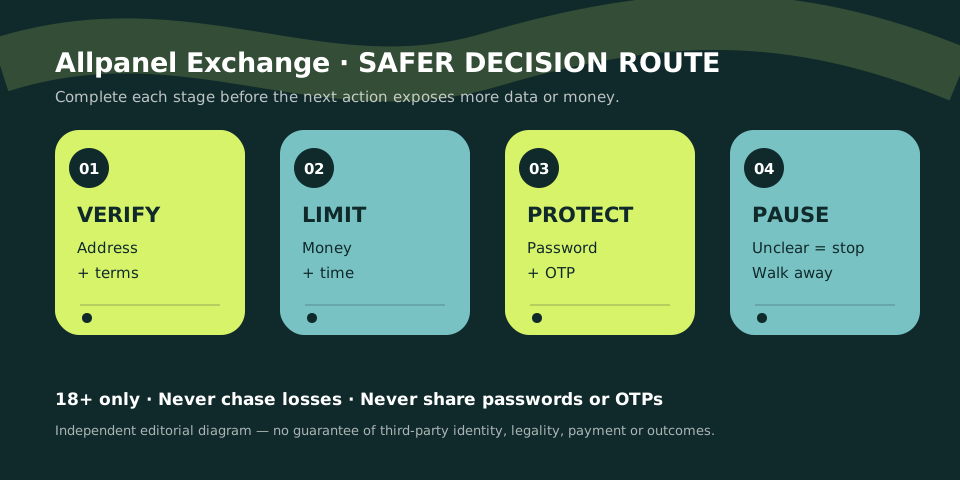
Work in sequence and write down the result of each check. A short record reduces the chance that urgency, memory or a persuasive chat message will replace the facts you actually observed. Allpanel Exchange Guide does not receive passwords, OTPs, payment credentials or identity documents, and it cannot verify private account outcomes.
Terminology before action
Six terms that make this page easier to use
Definitions matter because a familiar word can create false confidence. Read the term together with the rule, screen or evidence that gives it meaning. If a third-party page uses different language, do not assume the outcome or obligation is unchanged.
Recipient identity
The person or entity actually receiving funds, which should align with the service and published terms. In the context of Allpanel Exchange deposit, withdrawal and UPI safety, use this term only as precisely as the applicable page or rule allows; similar labels can conceal different conditions.
Transaction reference
The bank, card or wallet identifier that helps trace a payment without exposing secret credentials. In the context of Allpanel Exchange deposit, withdrawal and UPI safety, use this term only as precisely as the applicable page or rule allows; similar labels can conceal different conditions.
Withdrawal condition
A stated requirement affecting when funds can be requested, reviewed, limited or returned. In the context of Allpanel Exchange deposit, withdrawal and UPI safety, use this term only as precisely as the applicable page or rule allows; similar labels can conceal different conditions.
Turnover requirement
Activity that may be required before a promotional balance or related funds become withdrawable. In the context of Allpanel Exchange deposit, withdrawal and UPI safety, use this term only as precisely as the applicable page or rule allows; similar labels can conceal different conditions.
Release-fee scam
A demand for extra payment to unlock money, tax, verification or a frozen balance. In the context of Allpanel Exchange deposit, withdrawal and UPI safety, use this term only as precisely as the applicable page or rule allows; similar labels can conceal different conditions.
Dispute record
A chronological file of amounts, dates, recipients, terms and case numbers used in a complaint. In the context of Allpanel Exchange deposit, withdrawal and UPI safety, use this term only as precisely as the applicable page or rule allows; similar labels can conceal different conditions.
A repeatable process
Step-by-step checklist
Follow these steps in order. Earlier checks are deliberately low commitment; later steps can expose identity, device access or money. Stop as soon as a material requirement is unclear or conflicts with your legal, financial or personal boundary.
- Match the recipient
Confirm that the displayed payee is consistent with the accountable entity described in the terms. Complete this check before moving to a step that exposes more personal information or money. Record what you verified, where you found it and what remains uncertain.
- Read limits and fees
Check minimums, maximums, processing windows, currency conversion and verification requirements. Complete this check before moving to a step that exposes more personal information or money. Record what you verified, where you found it and what remains uncertain.
- Avoid third-party transfers
Do not send money to changing personal accounts or label a payment deceptively. Complete this check before moving to a step that exposes more personal information or money. Record what you verified, where you found it and what remains uncertain.
- Save the applicable terms
Keep a dated copy or screenshot showing the conditions presented before the transaction. Complete this check before moving to a step that exposes more personal information or money. Record what you verified, where you found it and what remains uncertain.
- Use an affordable amount
A transfer should never affect rent, food, debt payments, savings or another essential need. Complete this check before moving to a step that exposes more personal information or money. Record what you verified, where you found it and what remains uncertain.
- Record the reference
Store the amount, timestamp, recipient, hostname and provider reference in one timeline. Complete this check before moving to a step that exposes more personal information or money. Record what you verified, where you found it and what remains uncertain.
- Stop on new fee demands
Do not send additional money to release, verify or recover the original amount. Complete this check before moving to a step that exposes more personal information or money. Record what you verified, where you found it and what remains uncertain.
Compare the signal with the response
Decision table for Allpanel Exchange deposit, withdrawal and UPI safety
Use the table to convert observations into actions. It avoids two common extremes: treating a small positive sign as total approval, or continuing to send information and money merely to resolve uncertainty.
| What you observe | What it means | Safer next step |
|---|---|---|
| Recipient matches published entity | Traceability is stronger. This is a decision signal, not a complete safety verdict. | Continue checking the terms. Keep the response within your pre-set money, time and privacy boundaries. |
| UPI ID changes in chat | Accountability is weaker. This is a decision signal, not a complete safety verdict. | Do not transfer. Keep the response within your pre-set money, time and privacy boundaries. |
| Withdrawal rules are hidden | Future access is uncertain. This is a decision signal, not a complete safety verdict. | Do not deposit. Keep the response within your pre-set money, time and privacy boundaries. |
| A release fee is requested | High-risk recovery pattern. This is a decision signal, not a complete safety verdict. | Stop all further payments. Keep the response within your pre-set money, time and privacy boundaries. |
| Money is needed for essentials | Loss is unaffordable. This is a decision signal, not a complete safety verdict. | Keep it outside the activity. Keep the response within your pre-set money, time and privacy boundaries. |
Risks worth spotting early
Common mistakes and why they matter
Most preventable harm begins with a shortcut: assuming the name proves identity, letting urgency replace verification, or redefining an affordable limit after a loss. These patterns are more important than small cosmetic differences between pages.
Testing with a small payment
A successful deposit can create false confidence without demonstrating that larger withdrawals work. The practical correction is to pause, return to the relevant evidence and avoid making the next action larger simply because time has already been spent.
Paying a personal account
Changing individual payees can reduce traceability and conflict with the service identity. The practical correction is to pause, return to the relevant evidence and avoid making the next action larger simply because time has already been spent.
Ignoring promotional conditions
A bonus can introduce turnover, timing or eligibility restrictions that affect withdrawal. The practical correction is to pause, return to the relevant evidence and avoid making the next action larger simply because time has already been spent.
Sending secrets as evidence
An OTP, card security code or password is never needed to document a transaction dispute. The practical correction is to pause, return to the relevant evidence and avoid making the next action larger simply because time has already been spent.
Trying to recover loss with more money
Additional deposits increase exposure and can deepen both fraud and gambling harm. The practical correction is to pause, return to the relevant evidence and avoid making the next action larger simply because time has already been spent.
Put the checklist into practice
Three realistic scenarios
Scenarios reveal how several risks combine. The details will vary, but a sound response usually slows the decision, separates the communication route from the verification route and keeps financial exposure from growing.
The payee changes
Situation: A chat instructs the user to ignore the earlier recipient and transfer to a new personal UPI ID.
Safer response: Do not send the payment. Save the instruction, verify through the payment provider or a known service route, and treat inconsistent recipient identity as a material warning.
Notice the pattern: the response protects credentials, preserves a record and keeps the reader free to walk away. It does not promise that a disputed account, transaction or third-party service can be recovered.
A withdrawal needs tax first
Situation: An agent says a separate transfer is required before existing funds can be released.
Safer response: Stop. Do not pay a release fee or share banking credentials. Contact the bank or wallet using its official channel and preserve the complete transaction timeline.
Notice the pattern: the response protects credentials, preserves a record and keeps the reader free to walk away. It does not promise that a disputed account, transaction or third-party service can be recovered.
The records are scattered
Situation: Receipts, terms and chat messages sit across several apps after a disputed transfer.
Safer response: Create one chronological record with redacted copies, exact dates, the hostname and provider case numbers. A structured timeline is more useful than forwarding unrelated screenshots.
Notice the pattern: the response protects credentials, preserves a record and keeps the reader free to walk away. It does not promise that a disputed account, transaction or third-party service can be recovered.
Evidence boundary
What this guide can and cannot establish
This Allpanel Exchange page can explain deposit, withdrawal and transaction safety for Allpanel Exchange deposit, withdrawal and UPI safety, organise questions and show how to preserve useful records. It does not establish that a third-party domain is official, that an operator is licensed for a reader’s location, that a payment will be returned, or that any game outcome can be predicted.
Current details should be checked at the moment they matter. Terms, domains, app files, support routes and legal context can change. Prefer official primary material for changing public rules and use qualified professional advice when the consequences are material.
Keep sensitive information outside the research process. Redact passwords, OTPs, card security codes, recovery codes and unrelated identity data from any record you retain. If you suspect fraud or unauthorised access, use the official channel of your bank, payment provider, email service or relevant authority—not a number supplied by an unknown intermediary.
Clear answers
Frequently asked questions about Allpanel Exchange deposit, withdrawal and UPI safety
Does a successful deposit prove withdrawals work?
No. Money entering a route says nothing conclusive about later withdrawal, ownership or dispute handling. When a material fact is missing, keep the conclusion cautious and use the relevant internal guide to complete the next check.
Should I pay a fee to unlock funds?
No. Additional payment demands for release, tax or verification are a serious warning sign. When a material fact is missing, keep the conclusion cautious and use the relevant internal guide to complete the next check.
What payment evidence should I retain?
Keep amount, time, recipient, hostname, transaction reference, terms and official case numbers. When a material fact is missing, keep the conclusion cautious and use the relevant internal guide to complete the next check.
Can support ask for a banking OTP?
No. Never share banking passwords, OTPs or card security codes. When a material fact is missing, keep the conclusion cautious and use the relevant internal guide to complete the next check.
What if the recipient name is unfamiliar?
Pause the transaction and verify identity through a separate trusted route; do not rely on chat reassurance. When a material fact is missing, keep the conclusion cautious and use the relevant internal guide to complete the next check.